
AI Voice Agents for Healthcare
Answer patient questions, schedule appointments, and handle routine follow-ups around the clock. All handled by telli's voice agents, with full compliance built in, so your clinical staff can focus on care.












Industry Challenges
The reality of Healthcare operations today
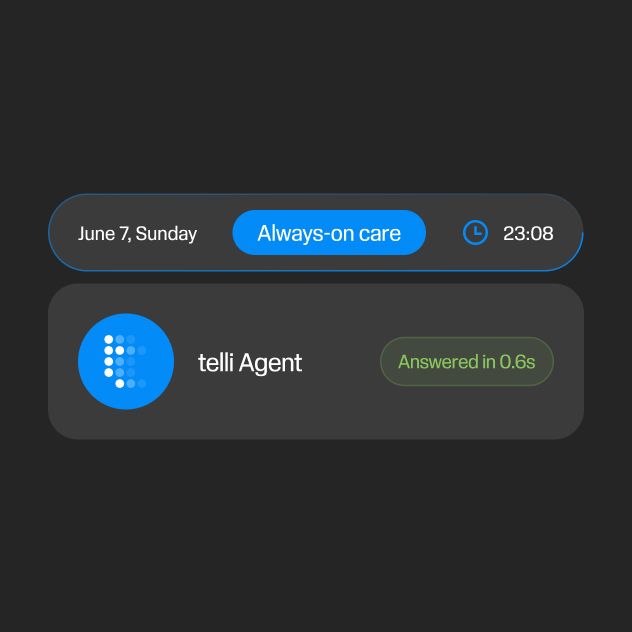
Patients can't reach your practice when they need to
Patients call when they're worried, when they need to reschedule, when they have a question about a prescription, when they want to book an appointment. They call at lunch, at 6pm, on Saturdays, and outside business hours when they don't know where else to turn. Most practices and care providers can't answer every call, so patients either sit on hold, hit voicemail, or give up and call someone else.
- Patient calls go unanswered during peak hours, lunches, and after-hours
- Long hold times damage patient experience and drive negative reviews
- telli answers every inbound patient call instantly, 24/7, and handles routine requests end-to-end
Front desk staff are buried in routine call work
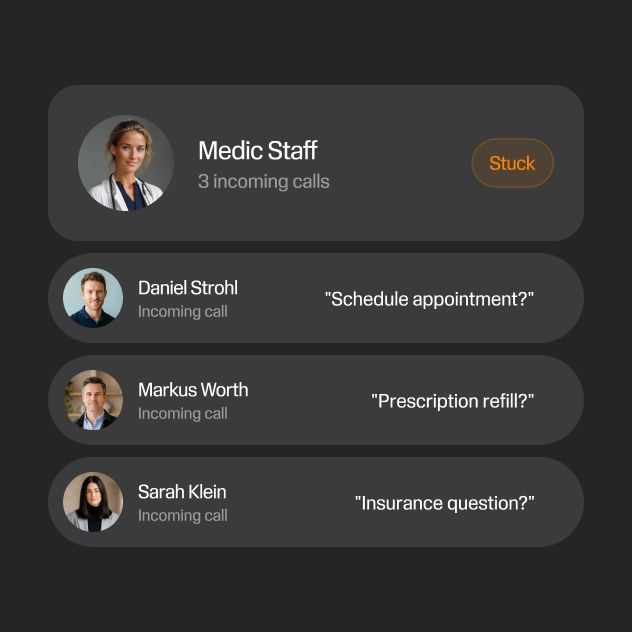
Appointment scheduling, rescheduling, no-show reminders, prescription refill requests, basic intake questions, insurance verifications, and post-visit follow-up calls consume hours of front desk and care team time every day. None of this work requires clinical judgment, but it still has to happen, and it pulls staff away from the patients who are physically in front of them.
- Routine scheduling and intake calls eat staff time that should go to patients on-site
- No-show rates stay high because reminder workflows aren't consistent
- telli handles scheduling, reminders, refill triage, and intake automatically, freeing staff for clinical work
Patient outreach and engagement falls through the cracks
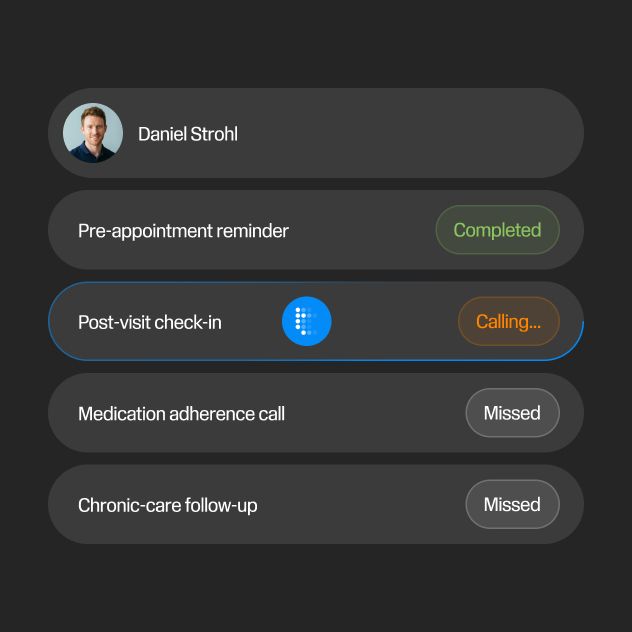
Care plans, prep instructions, recovery check-ins, satisfaction surveys, and chronic-care follow-ups all matter to outcomes, but they're the first things to slip when a team is short-staffed. Email reminders get ignored. SMS is a one-way channel. Manual outreach doesn't scale across thousands of patients, so engagement either gets templated into something generic or stops happening altogether.
- Proactive patient outreach (reminders, recovery check-ins, follow-up calls) doesn't scale manually
- Generic emails and SMS get ignored by exactly the patients who need engagement most
- telli runs personalized outbound check-ins and reminders in the background, automatically synced to your patient records
Read more about our product and features here
Our platformUse Cases
How Healthcare teams uses telli
AI Receptionist
Answer every patient call instantly, 24/7. telli handles appointment booking, prescription refill triage, basic intake questions, and routing, then escalates clinically sensitive calls to your staff with full context.
Customer Engagement
Run proactive patient outreach across the care lifecycle. From appointment reminders to recovery check-ins and chronic-care follow-ups, telli keeps patients engaged without adding work for your team.
Customer Support
Resolve patient inquiries faster. telli handles routine support questions (insurance details, visit prep, account information, portal access) end-to-end and warm-transfers complex cases to your staff with structured context.
Payment Reminders
Collect outstanding patient balances without straining the relationship. telli runs friendly payment reminder calls automatically, captures payment commitments, and routes disputes to your billing team.
Healthcare
Find out more about Healthcare with telli
Why phone-first AI is reshaping healthcare operations
Healthcare runs on the phone more than almost any other industry. Patients call to book appointments, ask about prescriptions, reschedule visits, follow up on test results, verify insurance, and ask the dozens of small questions that don't fit cleanly into a patient portal. Even with every patient-facing app and online booking tool in production, phone volume in most practices stays high, because patients call when they're worried, when something is urgent, or when they simply don't trust the digital channel for what they need.
The challenge isn't whether the phone matters in healthcare, it's that the call volume has structurally outgrown what most front desks and care teams can absorb. Patients hit voicemail, sit in hold queues, or get rerouted into phone trees that frustrate them. Staff get pulled off in-person care to handle routine calls. And the proactive outreach that drives real outcomes (reminders, follow-ups, care plan check-ins) is the first thing that slips when a team is stretched thin. The practices and care providers that solve this cleanly tend to see measurable improvements in patient satisfaction, no-show rates, and clinical outcomes; the ones that don't quietly lose patients to providers who answer the phone faster.
That's the opening voice AI was built for. telli's AI voice agents handle the high-volume routine calls that flood every healthcare operation — scheduling, rescheduling, reminders, intake, basic Q&A, payment follow-ups — while clinical staff stay focused on care and the more complex calls get cleanly escalated with full context already captured.
Where AI voice agents fit in a healthcare operation
The use cases that consistently produce the strongest results in healthcare fall into four buckets, all chosen deliberately to stay out of clinical decision-making and within operational and administrative work.
The first is inbound patient call handling. Most patient calls aren't clinical — they're scheduling, rescheduling, prescription refill triage, insurance questions, intake details, portal access help, and general practice information. telli answers every inbound call instantly, around the clock, and handles these requests end-to-end where possible. For calls that need a human (clinical questions, sensitive concerns, urgent situations), telli warm-transfers to the right staff member with a structured summary captured.
The second is proactive patient engagement across the care lifecycle. Appointment reminders, pre-visit prep instructions, post-visit recovery check-ins, medication adherence calls, chronic-care follow-ups, satisfaction surveys — all of these run better as voice conversations than as ignored emails or one-way texts, but they don't scale manually. telli runs these motions automatically in the background, references each patient's specific care plan or appointment, and syncs outcomes back to the patient record.
The third is no-show prevention and rescheduling. No-shows are one of the biggest operational and financial drags on most practices, and the difference between a 5% and a 25% no-show rate often comes down to whether reminder workflows actually run consistently. telli runs reminder calls 24 to 48 hours before each appointment, offers easy rescheduling on the call, and updates the schedule in real time so staff don't have to chase confirmations.
The fourth is patient billing and payment reminders. Outstanding balances, especially from co-pays and self-pay portions, often go uncollected simply because nobody has time to follow up. telli handles billing reminder calls in a friendly, non-aggressive tone, captures payment commitments, updates payment methods on the call, and routes disputes or complex situations to your billing team. Collection improves and the patient relationship stays intact.
Compliance and clinical safety as table stakes
Healthcare is the most regulated industry telli operates in, and that shapes how the platform is built and deployed. HIPAA compliance is a hard requirement, not a checkbox. GDPR applies for European patient data. Many practices also have to align with EU AI Act provisions, SOC 2 standards, and country-specific medical data regulations. telli is built with all of these in mind: encryption at rest and in transit, tightly controlled access, audited processes, EU hosting available for European deployments, and clear documentation for compliance teams.
Just as important is clinical safety. telli is intentionally scoped to operational and administrative tasks, not clinical decision-making. The AI doesn't give medical advice, diagnose conditions, or make clinical recommendations. It schedules, reminds, intakes, triages routine requests, and escalates anything clinical to the right human. This boundary is built into the platform deliberately, because the use of AI in healthcare requires careful guardrails around what's automated and what isn't. The practices that deploy telli successfully treat it as a way to free clinical staff to do clinical work, not as a way to automate clinical work itself.
Why healthcare teams choose voice AI over more administrative hires
The traditional way to handle patient call volume is to hire more administrative staff: more receptionists, more schedulers, more outreach coordinators. The economics of healthcare make this difficult. Margins are tight, especially for outpatient and primary care practices, and the labor market for skilled medical administrative staff is consistently constrained. Even when hiring is possible, training takes months, and turnover means the practice is constantly rebuilding capacity it just finished building.
Voice AI changes the math. telli handles unlimited concurrent calls without adding headcount, runs at a fraction of the cost of staffed alternatives, and delivers consistent service quality on every interaction. For most practices, this means patients stop sitting in queues, no-show rates drop, proactive outreach actually happens, and clinical staff get back the hours they were spending on routine phone work. The downstream effects on patient satisfaction scores and operational throughput tend to be visible within the first quarter.
Voice AI as a permanent layer of healthcare operations
The biggest shift telli sees with successful healthcare customers is that voice AI stops being a project and becomes infrastructure. It's not “what we use when we're short-staffed”, it's the always-on first layer that handles the majority of routine patient calls, runs the proactive outreach that drives outcomes, and routes the clinical work to the right humans with structured context already captured.
With telli running across your inbound and outbound patient communication, every call gets answered, every reminder goes out, every follow-up happens on time, and every clinically sensitive case lands on a staff member's desk with the context they need to handle it well. The practice gets quieter on routine work and sharper on care. Patients get a more reliable experience. The team that used to drown in scheduling and intake gets to spend more time on the work they actually trained for.
That's what AI voice agents look like when they're done right for healthcare: not a replacement for clinical judgment, but a permanent operational layer that absorbs the routine work, runs the engagement consistently, and lets the people who deliver care focus on delivering it.
Enterprise-Grade Protection by Default.

Resources
Other Resources
FAQ
Frequently Asked Questions
Is telli HIPAA-compliant for healthcare?
Yes. telli is built with HIPAA compliance as a core requirement, alongside GDPR, SOC 2, and alignment with the EU AI Act. All patient data is encrypted at rest and in transit, access is tightly controlled and audited, and EU hosting is available for European deployments. For healthcare customers, telli provides the documentation and operational controls compliance teams need to deploy voice AI responsibly.
Does telli give medical advice?
No. telli is intentionally scoped to operational and administrative tasks: scheduling, reminders, intake, basic Q&A, payment follow-ups, and routing. The AI does not diagnose conditions, recommend treatments, or make clinical decisions. Anything that requires clinical judgment gets warm-transferred to a qualified staff member with full conversation context attached. This boundary is built into the platform deliberately as a clinical-safety guardrail.
How does telli help reduce no-show rates?
telli runs reminder calls 24 to 48 hours before each appointment, offers easy rescheduling directly on the call, and updates the schedule in real time. Because the reminders are personal phone conversations rather than ignored emails or one-way texts, response rates and confirmation rates run significantly higher. Practices that automate this workflow with telli typically see no-show rates drop measurably within the first quarter.
Can telli handle prescription refill requests?
Yes, for routine triage. telli can capture refill requests, verify patient identity, log the request in your practice management system, and route the request to the appropriate clinical staff member for approval. The AI does not approve refills itself, that decision stays with the clinician, but it eliminates the front desk work of taking the request, capturing the details, and routing it correctly.
Does telli integrate with healthcare systems?
telli integrates with major CRMs and scheduling platforms (Salesforce, HubSpot, Calendly, Cal.com, custom calendars) and supports custom integrations for healthcare-specific systems via API. For practice management and EHR integrations, telli works with your existing system through standard APIs or middleware, depending on the platform. Talk to our team about your specific stack during the demo and we'll walk through what's possible.
How does telli handle clinically sensitive calls?
telli is designed to recognize when a call needs a human and to escalate cleanly. If a patient call involves clinical questions, urgent symptoms, mental health concerns, or anything outside the AI's defined scope, telli warm-transfers the call to the right staff member with a structured conversation summary, so the human steps in already knowing the patient's situation. The escalation logic is configurable per practice, so you can set the exact boundaries that match your protocols.
Can telli run multilingual patient communication?
Yes. telli supports over 40 languages with native-sounding accents, which matters for practices serving multilingual patient populations. The AI can detect the patient's preferred language and adapt mid-conversation, ensuring every patient gets a professional, comprehensible experience regardless of language.
How quickly can a healthcare practice deploy telli?
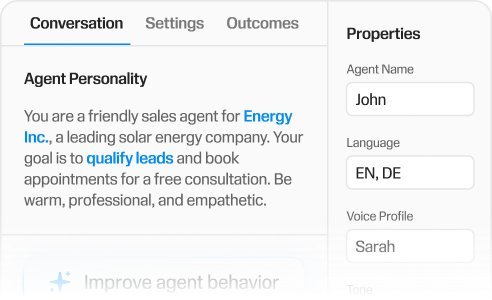
Most practices go live within days to a few weeks, depending on integration complexity and compliance review timelines. telli's prompt editor (telli studio) lets your team configure call flows, scripts, and escalation logic without engineering involvement, and standard CRM and scheduling integrations are ready out of the box. For HIPAA-regulated deployments, factor in additional time for your compliance team's review, but the platform itself is ready to deploy quickly.
Do patients know they're talking to AI?
Yes, and that's by design. telli's AI voice agents identify themselves clearly at the start of every call. In healthcare specifically, this transparency matters: patients consistently rate AI interactions higher when they know upfront that they're speaking with an AI than when they suspect it but aren't told. The trust dividend from being upfront is real, especially in a context as sensitive as healthcare.