
Guide To CSAT: How To Improve Customer Satisfaction Scores
Learn how to calculate, benchmark, and improve CSAT with proven customer support strategies and AI automation.
 Ranya Kharbach
- CSAT shows how customers feel immediately after a support, sales, onboarding, or service interaction, making it one of the clearest indicators of day-to-day customer experience quality.
- A strong CSAT score usually means customers are getting fast answers, clear communication, and successful resolutions without unnecessary transfers or repeat contacts.
- Low CSAT is often a sign of operational friction, such as long wait times, inconsistent agent quality, poor routing, or unresolved customer issues.
- CSAT is most useful when segmented by channel, team, issue type, and customer segment rather than treated as one company-wide average.
- The fastest ways to improve CSAT are reducing response times, improving first-contact resolution, giving agents better context, and automating repetitive customer interactions.
- AI voice agents like telli can improve CSAT by answering calls instantly, collecting context before escalation, routing customers correctly, and keeping service quality consistent during peak demand.
What Is CSAT?
CSAT stands for Customer Satisfaction Score. It is a customer experience metric used to measure how satisfied customers are after a specific interaction or experience with a company. Businesses typically collect CSAT feedback using surveys that ask customers to rate their experience on a scale such as 1–5 or 1–10.
Unlike broader metrics like Net Promoter Score (NPS), which measures long-term loyalty, CSAT focuses on immediate satisfaction. This makes it particularly valuable for evaluating support interactions, onboarding processes, sales calls, and issue resolution quality.
CSAT is widely used because it is simple to collect, easy to calculate, and highly actionable. Teams can quickly identify operational problems and measure the impact of process improvements over time.
CSAT Demo
Try calling one of telli’s voice agents to see how well it resolves your issue and how satisfied you feel after the conversation.
How Is CSAT Used?
Businesses use CSAT to evaluate the quality of customer experiences across support, onboarding, account management, and sales interactions. Because the metric captures immediate customer sentiment, it gives operational leaders fast insight into how customers perceive service quality.
Customer support organizations commonly use CSAT to measure agent performance, ticket handling quality, escalation effectiveness, and overall service consistency. Low scores often reveal operational problems such as long wait times, poor communication, insufficient training, or product-related issues.
CSAT is also widely used as a retention indicator. Customers who repeatedly report poor experiences are significantly more likely to churn or reduce product usage over time. For this reason, customer success and account management teams frequently monitor CSAT alongside retention and expansion metrics.
Many businesses also benchmark CSAT across support channels, products, customer tiers, and geographic regions. This helps identify which operational areas are performing well and which require process improvements.
For SaaS companies in particular, CSAT can act as an indirect product feedback mechanism. Repeated complaints about onboarding, usability, or troubleshooting often point to deeper product or workflow problems.
How To Calculate CSAT
CSAT is typically calculated using the following formula:
CSAT = (Number of Satisfied Responses ÷ Total Responses) × 100
Most businesses define “satisfied” responses as customers selecting the top two ratings on a five-point scale.
For example, if 85 out of 100 survey respondents select either 4 or 5, the CSAT score is 85%.
The simplicity of the metric makes it easy to track across support channels, departments, and geographic regions. Businesses often monitor CSAT weekly, monthly, and quarterly to identify trends.
Many companies also segment CSAT by support channel, issue type, or customer tier to identify specific operational weaknesses.
How To Design A CSAT Survey
A strong CSAT survey should be short, specific, and sent as close to the customer interaction as possible. The goal is not to collect a large amount of general feedback. The goal is to understand whether the customer was satisfied with a particular experience and why.
The best CSAT surveys are easy to answer, clearly tied to a recent interaction, and simple enough for teams to analyze at scale. If the survey is too long, vague, or delayed, response rates decline and the feedback becomes less reliable. A good CSAT survey should help the business identify what happened, where friction occurred, and what should be improved next.
Keep Surveys Short
CSAT surveys work best when they take only a few seconds to complete. Customers are usually responding after they have already spent time contacting support, speaking with a sales representative, or resolving an issue. Asking them to complete a long survey immediately afterward creates additional friction and can reduce response rates.
The most effective CSAT surveys usually include one primary rating question and one optional open-text follow-up. For example, a company might ask, “How satisfied were you with your support experience today?” followed by, “What could we have done better?” This structure gives the business a measurable score while still allowing customers to explain the reason behind their rating.
Keeping the survey short also improves data quality. When customers see a long list of questions, they may abandon the survey, rush through it, or provide less thoughtful answers. A short survey is more likely to capture honest, immediate feedback from a larger share of customers.
Send Surveys Immediately
Timing has a major impact on the accuracy of CSAT feedback. Surveys should usually be sent immediately after the customer interaction, while the experience is still fresh in the customer’s mind. If a survey is sent hours or days later, the customer may forget important details or be influenced by other experiences that happened afterward.
For support teams, this often means triggering a CSAT survey as soon as a ticket is closed, a call ends, or a live chat conversation finishes. For onboarding or sales teams, it may mean sending a survey after a completed demo, setup call, or appointment.
Immediate surveys are especially useful because they connect feedback to a specific operational moment. If several customers report poor satisfaction after similar interactions, teams can investigate the workflow, agent training, routing logic, or product issue behind the pattern. This makes CSAT more actionable than general customer feedback collected long after the experience.
Ask Specific Questions
Generic CSAT questions often produce generic answers. Asking “How satisfied are you with our company?” may be useful for broad brand research, but it is less helpful for improving a specific workflow. A better CSAT survey should refer directly to the interaction the customer just had.
For example, instead of asking, “How was your experience?” a support team might ask, “How satisfied were you with how we handled your billing question today?” A recruiting team might ask, “How satisfied were you with your scheduling call?” A sales team might ask, “How satisfied were you with your product demo?”
Specific questions make it easier to connect feedback to real operational improvements. They also help customers provide more accurate answers because they know exactly what they are being asked to evaluate. When the question is tied to a clear interaction, the resulting CSAT data is more useful for coaching agents, improving workflows, and identifying recurring issues.
Use Consistent Scoring
Consistency is essential if CSAT data is going to be useful over time. Companies should avoid changing rating scales, survey wording, or scoring rules too frequently. If one team uses a five-point scale, another uses a ten-point scale, and another uses emojis or thumbs-up responses, it becomes difficult to compare results accurately.
Most companies use a five-point scale because it is simple for customers and easy for teams to analyze. In that format, responses of 4 and 5 are typically counted as satisfied. The CSAT score is then calculated as the percentage of satisfied responses out of total responses.
Using consistent scoring allows businesses to benchmark performance across teams, channels, time periods, and customer segments. It also makes trends easier to interpret. If CSAT drops from 84% to 76%, leaders can be more confident that the change reflects a real experience issue rather than a change in survey design.
Consistency does not mean the survey can never evolve. However, changes should be intentional and documented so teams understand how they affect historical comparisons.
CSAT Benchmarks
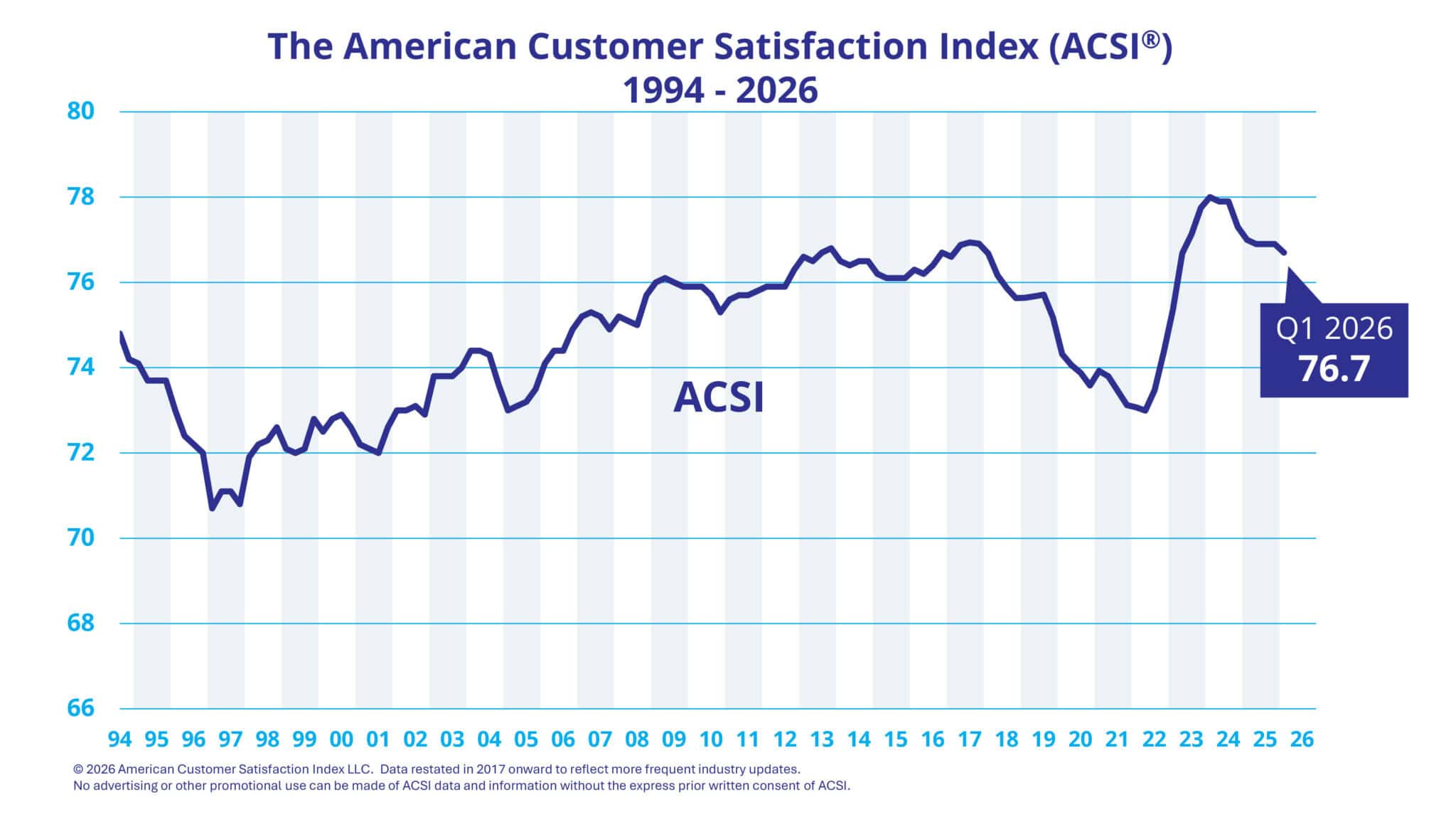
Each year, the American Customer Satisfaction Index /ACSI) collects data about CSAT industry benchmarks, broken down by industry and company.
According to ACSI, customer satisfaction is a key measure of both company performance and broader economic health. Firms with higher satisfaction scores often see stronger stock performance, while changes in satisfaction can predict consumer spending and GDP growth. Since consumer spending makes up most U.S. GDP, improving product and service quality supports economic growth. ACSI research also shows that manufactured goods usually receive higher satisfaction scores than services, as service-heavy industries tend to score lower. Quality matters more than price in most industries, making long-term quality improvements more effective than price cuts. Mergers and acquisitions often reduce satisfaction, especially in services.
Here are the numbers for 2025 and 2026:
By Industry
- Consumer Shipping and Mail: 78 in 2026 (up from 77 in 2025, +1% increase)
- Energy: 73 in 2026 (down from 74 in 2025, which could be due to a number of reasons, but chief among them may be a general dissatisfaction with rising costs)
- Life Insurance: 78 in 2025 (down from 79 in 2024, -1% decrease)
- Health Insurance: 76 in 2025 (no change from 2024)
- Banks: 80 in 2026 ( no change from 2025)
In general, CSAT scores have been trending downwards across industries after experiencing a rapid upwards trajectory from 2022-2025. Customer complaints have now reached record levels and bolder solutions - such as better training and technologies like AI voice agents — are needed to buck the trend.
Ways To Improve CSAT
Improving CSAT usually comes down to removing friction from the customer experience. Customers want fast responses, clear communication, and confidence that their issue is being handled correctly. When support journeys feel slow, repetitive, or disorganized, satisfaction drops quickly.
The most effective CSAT improvements are usually operational rather than cosmetic. Companies improve satisfaction by reducing wait times, resolving more issues on the first interaction, giving agents better customer context, and using automation where it improves speed or consistency.
Reduce Wait Times
Long wait times remain one of the most common causes of customer dissatisfaction. Customers increasingly expect fast, convenient service across phone, chat, and digital channels. When they have to sit on hold, wait hours for a callback, or repeat themselves after being transferred, the experience starts poorly before the actual issue is even addressed.
Reducing wait times usually requires better workforce planning, smarter routing, improved forecasting, and automation. For phone-based teams, AI voice agents like telli can help by answering calls instantly, handling routine requests, and collecting customer context before a human agent needs to step in. This helps reduce queue pressure without forcing companies to hire more agents for every spike in demand.
The goal is not simply to make every interaction shorter. The goal is to make the first few moments of the customer experience feel responsive, organized, and useful. Even when an issue needs human support, customers are more satisfied when they feel the business has acknowledged them quickly and moved them in the right direction.
Improve First Contact Resolution
Customers become frustrated when they need to contact a company multiple times to resolve a single issue. Every repeat call, transfer, or follow-up creates more effort for the customer and increases the chance that they will leave the interaction dissatisfied. This is why first contact resolution is one of the strongest drivers of CSAT.
Improving FCR usually requires better agent training, clearer internal documentation, stronger escalation paths, and more unified customer systems. Agents need access to the right information at the right time, including account history, previous interactions, open tickets, and relevant policies.
AI voice agents can support FCR by gathering information before escalation, identifying the reason for the call, and routing customers to the right team from the start. For simpler requests, they may be able to resolve the issue entirely without a human handoff. For more complex cases, they can make the human interaction more efficient by ensuring the agent already has the context needed to help.
Personalize Customer Interactions
Modern customers expect companies to understand who they are and why they are reaching out. They do not want to explain the same issue repeatedly or provide information the business should already have. When customers feel unknown or unsupported, the interaction becomes frustrating even if the final answer is technically correct.
Personalization starts with connected systems. Support teams need access to CRM records, previous tickets, purchase history, product usage, and communication preferences. With that context, agents can acknowledge the customer’s situation, avoid repetitive questions, and tailor the conversation to the actual problem.
AI-assisted workflows can also improve personalization when used carefully. For example, an AI voice agent can recognize returning callers, verify key details, and summarize the customer’s reason for contacting the business before routing the conversation. This creates a smoother experience while still allowing human agents to handle sensitive, complex, or high-value interactions.
Improve Agent Training
Even strong support systems fail if agents lack the product knowledge, communication skills, or authority required to solve customer problems effectively. Customers notice when agents sound unsure, follow scripts too rigidly, or need to escalate basic issues. These experiences can reduce CSAT even when the customer eventually receives an answer.
High-performing support organizations continuously coach agents using call reviews, quality assurance scoring, customer feedback, and performance data. Training should cover not only product knowledge, but also tone, empathy, de-escalation, troubleshooting, and when to involve a specialist.
AI can support agent training by helping teams identify patterns across calls, such as recurring objections, common escalation points, or moments where customers become frustrated. Voice agents like telli can also reduce the number of repetitive calls human agents handle, giving teams more capacity to focus coaching on complex interactions where human skill matters most.
Automate Repetitive Requests
Many customer interactions are repetitive. Customers often call about appointment scheduling, order updates, billing questions, account verification, password resets, delivery status, or basic product information. When these requests are handled manually, they consume agent time and increase queues for customers with more urgent or complex needs.
Automation can improve CSAT when it removes unnecessary effort from the customer experience. An AI voice agent can answer common questions, update records, schedule appointments, confirm details, and route calls without making customers wait for a live agent. This gives customers faster service while allowing support teams to reserve human attention for situations that require judgment, empathy, or negotiation.
The key is to automate the right interactions. Poor automation can make customers feel trapped or ignored. Strong automation gives customers quick answers, clear escalation options, and a seamless handoff when human support is needed.
How AI Voice Agents Like telli Help Companies Improve CSAT
90%
of information-gathering calls handled by a telli agent
75%
reduction in time spent advancing candidates
AI voice agents improve CSAT when they make the customer experience faster, more natural, and easier to complete. The biggest opportunity is not simply “deflecting calls.” It is removing the slow, repetitive parts of phone-based workflows so customers, candidates, or prospects can get what they need without waiting for a human team to become available.
telli is especially useful for high-volume call workflows where teams need to collect information, qualify inbound demand, confirm details, route people correctly, or answer common questions. Instead of forcing every caller into the same queue, telli’s AI voice agents can handle conversations automatically while preserving a natural, human-like experience.
Zenjob is one relevant example. The company used telli to automate initial candidate screening calls for Zenjob Pro, its long-term staffing product. Before telli, recruiters had to spend time on ten-minute preliminary calls to collect candidate information before deciding whether someone should move to a full interview. As application volume increased, this became a bottleneck.
With telli, Zenjob automated 90% of its information-gathering calls and reduced the time spent advancing candidates by 75%. The voice agents call applicants, review position requirements, ask about previous work experience, and collect the information recruiters need to make the next decision. Human recruiters still decide whether a candidate moves forward, but they can now review transcripts and AI-generated summaries instead of conducting every initial call manually.
That matters for CSAT because speed and convenience are major drivers of satisfaction. Zenjob’s candidates can complete screening calls seven days a week, including weekends when students are more likely to be available. The experience also feels natural because telli’s agents were tailored to Zenjob’s tone, language, and workflow. According to Zenjob, candidate CSAT for these AI-led calls has remained at a steady 9 out of 10.
For customer support teams, the same principle applies. telli can help companies reduce wait times, gather context before escalation, answer repetitive questions, and route callers to the right team with better information attached. This creates a smoother experience for customers while giving human agents more time to focus on complex or sensitive conversations.
The best AI voice agent deployments do not replace human service quality. They protect it. By automating the repetitive and time-sensitive parts of the customer journey, telli helps companies scale phone operations without making customers wait longer, repeat themselves, or deal with inconsistent service during peak demand.
Frequently Asked Questions
Most businesses consider a CSAT score between 75% and 80% to be strong, although benchmarks vary by industry and customer expectations. High-performing customer support organizations often exceed 85%, particularly in industries where responsiveness and service quality are major competitive differentiators. Technical support environments sometimes operate with slightly lower averages because issue complexity is higher.
CSAT measures how satisfied customers are with a specific interaction, such as a support call or onboarding session. NPS, or Net Promoter Score, measures long-term customer loyalty by asking whether customers would recommend a company to others. CSAT focuses on operational experiences, while NPS evaluates overall brand perception and relationship strength.
Most organizations measure CSAT immediately after customer interactions because transactional feedback is more accurate and actionable than delayed surveys. Support teams commonly trigger CSAT surveys after ticket closures, phone calls, onboarding sessions, or live chat conversations. Continuous measurement helps companies identify trends quickly and respond to operational issues before they affect retention.
The biggest drivers of CSAT are usually response speed, first-contact resolution, communication quality, and overall service consistency. Customers expect businesses to resolve issues quickly without requiring repeated follow-ups or transfers. Poor wait times, fragmented workflows, and inconsistent support experiences tend to reduce satisfaction scores significantly across nearly every industry.
Maybe you’re also interested in
Churn Rate: How To Measure, Benchmark, And Reduce Customer And Employee Churn
A practical guide to understanding both customer and employee churn, the benchmarks that matter, and how AI voice agents can reduce attrition across the board.
Read nowLead Conversion Rate: What It Means, How To Measure It, And How To Improve It
Everything you need to know about tracking, benchmarking, and improving lead conversion rate, and where AI voice agents make the biggest difference.
Read nowFirst Contact Resolution Rate: What It Is, How To Measure It, And How To Improve It
Learn how to calculate FCR, benchmark your performance against industry standards, and use AI voice agents to resolve more issues on the first call.
Read nowGuide To CSAT: How To Improve Customer Satisfaction Scores
Learn how to calculate, benchmark, and improve CSAT with proven customer support strategies and AI automation.
Read now