Successful AI voice agent deployment depends far more on upfront preparation than the underlying software. Follow this step-by-step guide to map workflows, configure integrations, test thoroughly, and execute a seamless phased rollout.
Two companies buy the same AI voice platform in the same quarter. Company A assumes implementation means connecting an API and flipping a switch. They skip documenting call flows, upload a scattered mess of outdated FAQs, and launch to their entire call volume on day one. Automation rate stalls in the low 20s, transfers spike, and within a month the project is quietly labelled "not ready yet."
Company B spends two extra weeks upfront: mapping their actual call flows, cleaning up their knowledge base, and picking one call type to pilot first. They launch to a single team, watch the numbers for two weeks, fix what's broken, and only then expand. Three months later, they're running the platform across their full call volume with automation rates twice what Company A managed.
Same software. Completely different outcome. The difference is what happened before deployment, not the deployment itself.
Most failed implementations don't fail because the AI wasn't good enough. They fail because nobody defined precisely what "working" meant before launch. "We want to automate calls" isn't a goal you can measure against; "reduce missed calls by 30%" or "book 50% of appointments without a human touching the calendar" is.
A simple goal-to-KPI framework, worth setting before any implementation work begins:
Goal | KPI |
|---|---|
Book appointments without manual scheduling | Booking Rate |
Reduce team workload from repetitive calls | Automation Rate |
Improve the caller's experience | CSAT |
Qualify inbound leads before sales calls | Qualified Lead Rate |
Reduce missed or abandoned calls | Missed Call Rate |
telli's own onboarding process is built around exactly this principle: rather than jumping straight into building an agent, the first step is picking one specific use case, ideally a simple, high-impact scenario, and defining a single KPI that will indicate success before touching any configuration. Starting narrow isn't a limitation of the platform; it's what makes the first weeks of any implementation clear enough to actually learn from.
An AI voice agent implementation always works within the existing support framework. It rarely replaces a system that nobody has documented, so map the support processes that already exist. Some conversation design basics are universal, but each team may have their own way of routing, escalating, and documenting calls. A simple diagram looks like this:
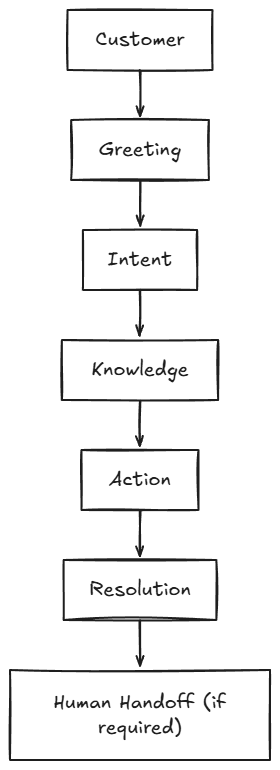
Skipping this step is one of the easiest ways to implement an AI voice agent in a way that makes nobody happy. If the team has no idea what actions the caller is routed to and why, there is no way to prepare the knowledge base correctly. If nobody documents what qualifies for human assistance, the agent will have no ability to distinguish between simple and complex queries.
An AI voice agent can only answer accurately if the underlying information is actually there to retrieve. This is worth separating clearly from a common misconception: training a model and giving it a knowledge base are not the same thing. A model's general training doesn't include your specific pricing tiers or cancellation policy; that has to come from documents you provide, searched at the moment a caller asks. We've covered exactly how that retrieval process works in How AI Voice Agents Work, if you want the full technical picture.
A quick knowledge readiness checklist before implementation begins:
Good conversations don't come from the underlying technology. They come from deliberate design. This covers greetings, how the agent detects intent, what it asks when a request is ambiguous, how it confirms details back to the caller, how it handles being misunderstood, when it escalates, and how it closes a call cleanly.
A short example, greeting to resolution:
Notice what's missing: a menu, a script that ignores what the caller actually said, or a rigid decision tree. Natural conversation design consistently outperforms rigid scripting, because callers don't phrase requests the way a flowchart expects them to. We’ve explored prompt engineering in more detail here, so make sure you check that out.
Once the conversation itself is designed, the agent needs to connect to the systems that make it useful: CRM, calendars, helpdesk software, payment systems, and any internal tools relevant to the workflow.
A simple integration flow:

telli's platform reflects this directly in how it's built: native integrations with systems like Salesforce and HubSpot, real-time tool calls the agent can trigger mid-conversation (checking availability, verifying a customer, hitting a custom endpoint), and post-call workflows that push structured outcomes into whatever system a team already uses. The point of all of this isn't the integration itself; it's making sure nothing the AI does mid-call requires a human to go back and manually re-enter it afterward.
Testing is one of the most important steps in implementation, as well as one of the most frequently cut due to time constraints. Before going live, test the agent’s performance on:
Testing also includes user acceptance tests (UAT): representatives from the support team can simulate real customer calls to find any major issues before the wider audience encounters them. telli’s in-app tools also allow simulating prompts: a team can call or send a message to the agent directly to try out a prompt update before launching it, and A/B test different versions of the prompt to see which performs better.
A phased rollout always performs better than attempting to automate everything at once. According to RAND’s research on AI implementation failures, over 80% of AI projects fail, roughly twice the failure rate of IT projects that don't involve AI. That is nearly double the technical project failure rate. The causes are varied but include poor planning, incomplete documentation, and rushing the launch before preparing the team.
A rollout plan can be as simple as the following:

The point of a staged launch is to collect analytics before launching to more teams: what works for one department may not scale well to another. That is why telli’s customers tend to follow a similar pattern when launching new features: enerix, for instance, began using telli’s lead capture functionality with two franchises before expanding to 15 of its more than 100 franchises.
Implementation doesn’t end at launch. It is critical to establish a feedback loop after the agent goes live to understand how it can be improved. Some metrics tend to be especially informative after launch: automation rate, transfer rate, CSAT, first contact resolution, lead conversion rate, response time, and booking rate. A good optimisation cycle looks like this:

It should take place regularly and be ongoing, not a one-time event at the end of implementation. Customers’ needs evolve, and so do their expectations. A prompt that worked well a year ago may no longer be intuitive, and the knowledge base that was current at launch may now be out of date.
Impact: the agent fails at basic questions and provides incorrect information. A good practice is to review and update the documentation before implementation begins, not after launch.
Impact: customer calls stop dead in their tracks when the agent has no idea what to do. Have a strategy in mind for when and how the call should be escalated to a human.
Impact: no understanding of what drives performance. It is important to capture the metrics discussed above in day-to-day operations rather than waiting for traffic to grow.
Impact: customers feel trapped in an endless loop with no way to speak to a person. Always design a clear and accessible path to a human agent.
Impact: customers become the QA team for the implementation. Conduct tests, including UAT (user acceptance testing), to make sure that the agent handles difficult requests, interruptions, accents, and other challenges.
Impact: no one knows whether the implementation is working. Define what constitutes a “worked” call before launch, including a single measurable KPI.
Successful implementation depends on planning, knowledge preparation, conversation design, integrations, testing, and continuous optimisation, not simply picking the right software. Choosing the right AI voice agent platform is only one part of the process; how you actually roll it out is what determines whether it works.
It depends on the scope of the implementation, but any project can begin with a narrow use case and go live within a few weeks, assuming the knowledge base and conversation design are well-prepared. The full launch timeline for an organisation-wide automation typically spans several months.
A clearly defined business goal or goals, documented call flows, a prepared knowledge base, and integrations set up (CRM, telephony, calendar).
Yes, most established platforms support native integrations with systems like Salesforce and HubSpot, along with custom API or webhook support for anything more specific to your business.
No, at least not for the duration of the implementation. Most phone systems can be ported over to the new service or used alongside it as a backup.
Through structured UAT covering edge cases, interruptions, accents, background noise, wrong-answer scenarios, and escalation paths, ideally involving actual frontline staff rather than only engineers.
Automation rate, transfer rate, CSAT, first contact resolution, lead conversion, response latency, and booking success rate, reviewed on a recurring cadence rather than as a single post-launch check.
Learn how AI voice agents work from speech recognition and LLM reasoning to knowledge retrieval, APIs, and natural voice responses.
Read nowThe secret to a reliable AI voice agent lies in its prompt, not just the underlying language model. Discover best practices for crafting, testing, and securing conversational prompts that drive real business results.
Read nowIn this guide, we give you a comprehensive breakdown of how to test your AI voice agents, including industry benchmarks you should be aiming for.
Read nowLearn how to calculate FCR, benchmark your performance against industry standards, and use AI voice agents to resolve more issues on the first call.
Read now
 Ranya Kharbach